


Contents
- Scalping Explained in Simple Terms
- What Does It Mean to Scalp?
- Scalping on an Exchange: What It Is and How It Works
- How Scalping Differs from Other Types of Trading
- Why Scalping Is Popular in Cryptocurrency
- What a Scalping Trade Looks Like
- What You Need for Scalping
- Advantages of Scalping
- Disadvantages and Risks of Scalping
- Is Scalping Suitable for Beginners?
- Conclusion
What Is Cryptocurrency Scalping: A Complete Guide for Beginners
When a person first enters trading, they quickly come across different trading styles: some traders hold positions for weeks, some trade intraday, and others open and close positions within minutes or even seconds. The last approach is called scalping.
In the simplest terms, scalping is trading short price movements. A trader does not try to catch a global trend and does not wait for an asset to grow by dozens of percent. The goal is to find a small move, enter the trade quickly, capture part of the impulse, and exit before the market changes direction.
In this article, we will break down what scalping is in trading, how it works in the cryptocurrency market, how it differs from other approaches, and why beginners should understand not only the opportunities but also the risks of this trading style.
Scalping Explained in Simple Terms
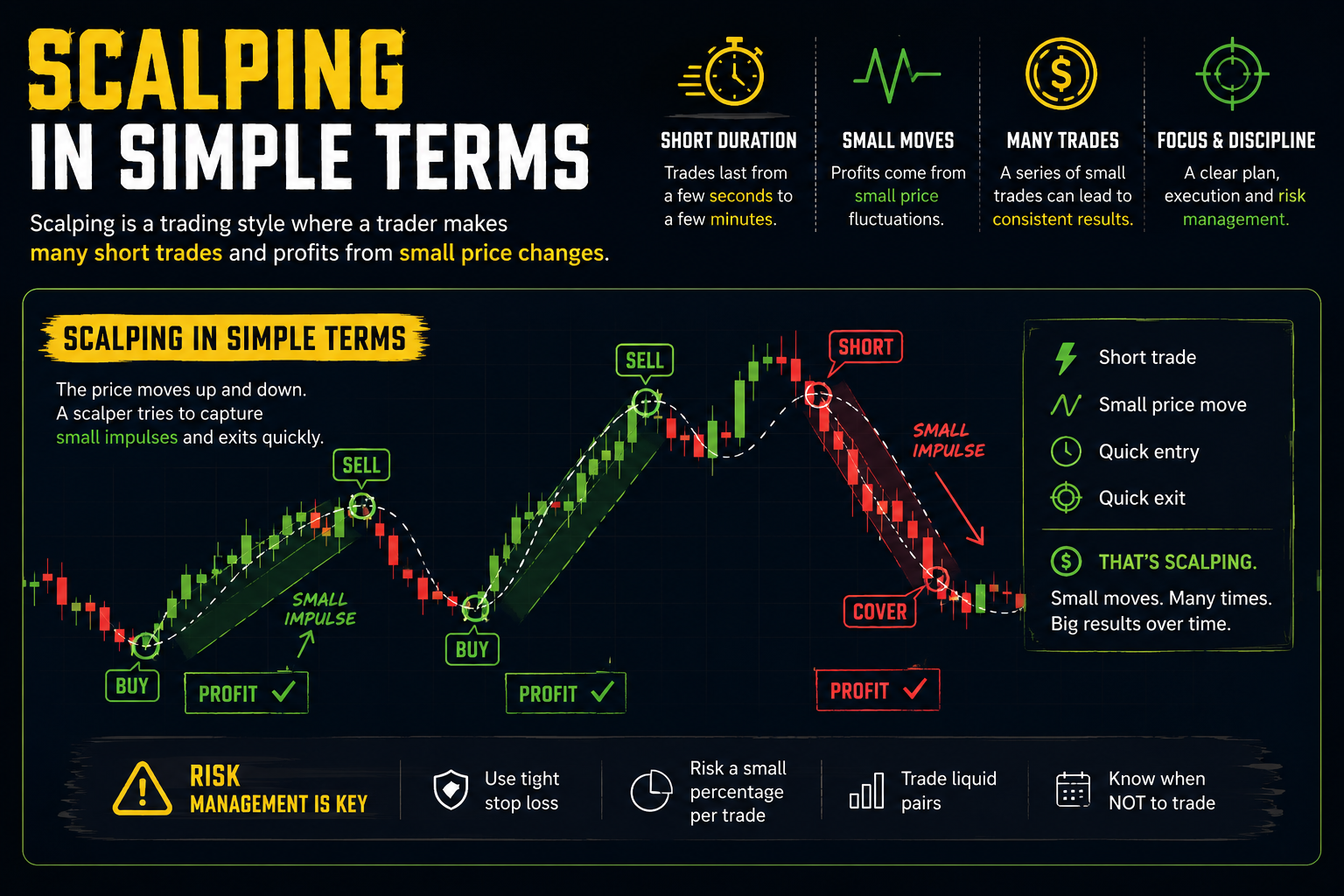
Scalping is a trading style in which a trader makes many short trades and tries to profit from small price changes. Usually, such trades last from a few seconds to a few minutes. Sometimes a position may be held longer, but the logic remains the same: capture a short move rather than stay in a trade for hours.
To explain scalping in simple terms, imagine that the price of a cryptocurrency is constantly making small fluctuations up and down. A scalper tries to capture part of these fluctuations. The trader buys when they see a short-term opportunity for growth and quickly sells when the move plays out. Or, conversely, opens a short position if they expect a quick decline.
That is why search queries such as “what is scalping,” “what is scalping in simple terms,” or “what does scalping mean” usually come from people who want to understand the basic mechanics: a trader makes money not from one large move, but from a series of small trades.
Scalping in trading is not a way to “press buttons quickly at random.” On the contrary, good scalping requires a clear system: where to enter, where to exit, what risk to take, which coin to choose, and when it is better not to open a trade at all.
What Does It Mean to Scalp?
The phrase “to scalp” means to trade using the scalping approach. In other words, it means looking for short-term market situations and quickly opening trades with small targets.
When someone asks “what does it mean to scalp” or “what is scalping on an exchange,” they are usually not talking about a specific button or exchange function. It is a particular style of trader behavior in the market.
A scalper constantly watches the price, order book, time and sales, volumes, and the reaction of market participants. They do not wait for a perfect entry on the daily chart. They are interested in what is happening here and now: where a liquidity wall has appeared, where a large volume has gone through, where the price has accelerated sharply, and where buyers or sellers have started to push more aggressively.
That is why scalp trading is highly intense. A trader needs to process information quickly, make decisions, and control risk. In this sense, scalping is closer to active market work than to calm investing.
Scalping on an Exchange: What It Is and How It Works
Scalping on an exchange is trading inside a trading platform, where a trader buys and sells assets based on short price movements. In crypto, this can be done on the spot market or with futures.
If we explain what scalping on an exchange is in simple terms, the process looks like this: a trader selects a liquid coin, watches the short-term price movement, finds an entry point, opens a position, and closes it when a small target is reached or when the stop-loss is triggered.
The main feature is that a scalper cares not only about the price itself. The trader also cares about how exactly the price is moving. A smooth move without volume is one thing; a sharp impulse with active trades in the tape is another. An empty order book is one thing; a dense order book with clear orders near the price is another.
That is why scalping on an exchange requires attention to detail. The trader evaluates not only the chart, but also the quality of the instrument: liquidity, spread, volume, speed of movement, order book depth, and fees. If an asset is poorly traded, even a good idea can turn into a bad trade because of slippage or the inability to exit the position quickly.


How Scalping Differs from Other Types of Trading
To better understand what scalping is in trading in simple terms, it is useful to compare it with other approaches.
An investor may buy an asset and hold it for months or years. They are interested in the long-term idea, the project’s fundamentals, market development, and the overall price dynamics.
A swing trader may hold a trade for several days or weeks. They look for larger moves and do not react to every small pullback.
An intraday trader works within the day. They may open one or several trades and close them before the end of the trading session.
A scalper works even faster. The goal is not to predict the movement for the next week, but to understand what may happen in the next few minutes. Therefore, in simple terms, scalping in trading is trading short-term market situations where speed, discipline, and precise execution matter.
But high speed does not mean chaos. The shorter the trade, the more important it is to understand the scenario in advance. A scalper does not have much time for long thinking after entering a position. If the plan was not ready before the trade, emotions quickly start to interfere while the position is open.
Why Scalping Is Popular in Cryptocurrency
The cryptocurrency market is well suited for active trading for several reasons. It operates 24/7, which means movement can appear at any time. Popular coins usually have high liquidity, an active order book, and a large number of participants. In addition, cryptocurrencies often show strong volatility, and movement is exactly what a scalper needs to find trades.
But it is important to understand that volatility is not only an opportunity, but also a risk. The price can move sharply in the desired direction, but it can also reverse just as quickly. That is why scalping requires strict position control. You cannot simply hope that the market will “come back soon.” If the scenario breaks, the trade must be closed according to a predefined rule.
In crypto, scalpers often use not only the chart, but also additional tools: the order book, time and sales, volumes, levels, liquidity walls, futures data, and Bitcoin’s behavior as the main market benchmark. This helps them understand more accurately where there is real interest from participants and where a move may simply be random noise.


What a Scalping Trade Looks Like
Imagine a simple situation. A coin has been trading in a range for a long time and then approaches a strong resistance level. In the order book, large orders are visible near this level, but the time and sales show active buying. The price tests the area several times, sellers cannot push the market down strongly, and at some point a breakout occurs.
A scalper may consider an entry not just because “the price is rising,” but because they see a specific mechanism: the level, buyer pressure, volume, order book reaction, and acceleration of the movement. After entering, the trader already understands where they will take profit and where they will exit if the breakout turns out to be false.
This is an important point. What is scalping in trading? It is not just a fast trade. It is a fast trade with clear logic. If a trader enters only because the candle turned green, that is not a system. That is an attempt to chase the market.
What You Need for Scalping
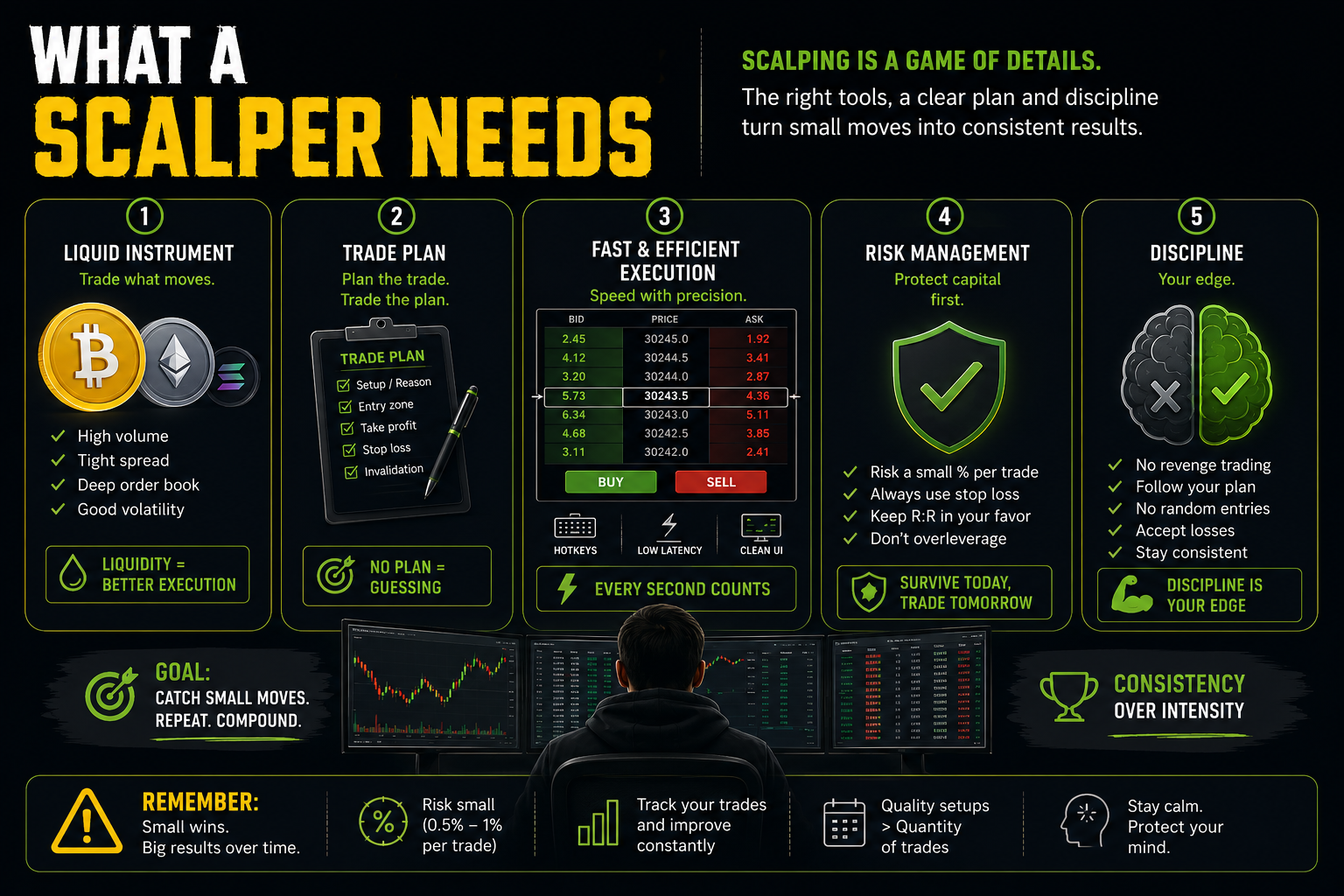
For scalping, it is important to choose the right instrument. Not every cryptocurrency is suitable for active trading. If a coin has low volume, a wide spread, and an empty order book, a scalper may face poor execution. The trader may correctly determine the direction, but enter or exit at an unfavorable price.
A trading plan is also necessary. Before a trade, the trader must understand why they are entering, where they will exit, what risk they are taking, and under what conditions the scenario will be canceled.
Another important element is execution speed. This does not mean pressing buttons mindlessly. But the interface, terminal, hotkeys, order book, and order management must be convenient. In scalping, extra seconds can sometimes affect the outcome of a trade.
And, of course, discipline is required. Scalping quickly reveals a trader’s weak points. If a person tends to revenge trade, move stop-losses, increase position size after a loss, or enter without a signal, these mistakes show up especially quickly in short trades.
Advantages of Scalping
The main advantage of scalping is the large number of trading opportunities. During the day, the market can provide many short-term moves, especially in active cryptocurrencies. A trader does not have to wait several days for one signal. They can work with what is happening in the moment.
Another advantage is the quick result of a trade. A scalper understands almost immediately whether the idea is working or not. If the scenario is confirmed, the position can quickly move into profit. If not, the trade is closed by stop-loss, and the trader moves on to the next analysis.
Scalping also helps traders better understand market mechanics. A person starts to see how the price reacts to levels, how impulses appear, how the order book behaves, and where participants begin actively buying or selling. This can be useful for learning because the trader constantly observes the live reaction of the market.
But these advantages only work when there are rules. Without a system, a large number of opportunities turns into a large number of random trades.
Disadvantages and Risks of Scalping
The main disadvantage of scalping is the high workload. A trader needs to maintain attention for a long time, make decisions quickly, and stay in control after a series of trades. This is more exhausting than it may seem from the outside.
The second risk is fees. Since a scalper makes many trades, fees can noticeably affect the final result. If a strategy captures a small movement but does not account for fees and slippage, the real profit may turn out to be much lower than expected.
The third risk is emotional mistakes. A fast market easily provokes FOMO, the desire to win back losses, the fear of missing a move, and impulsive entries. That is why scalping can be more difficult for beginners than it seems. It requires not only knowledge, but also psychological stability.
Another risk is trading unsuitable coins. If a beginner chooses an asset only because it has sharply increased, but does not look at liquidity and the order book, they may end up in a situation where exiting the trade is harder than entering it.

Is Scalping Suitable for Beginners?
Scalping can be useful for beginners as a way to study the market quickly, but it should be approached carefully. It is not the easiest trading style because it requires speed, discipline, and an understanding of market mechanics.
A beginner should not start with large position size and high risk. It is much more important to first learn how to read the chart, understand levels, see liquidity, work with the order book, and record trades in a journal. At the first stage, the goal is not to make money quickly, but to understand how the market behaves in the moment.
If a trader sees scalping as a speed game, they will quickly face losses. But if they approach it as a system with rules for entries, exits, and risk, this style can become a working tool.
Conclusion
Scalping is an active trading style based on short trades and small price movements. If we answer the question “what is scalping in trading,” it is a way to work with the market over short periods of time, where speed, precision, and discipline are important.
In simple terms, scalping in trading is an attempt to capture a small part of a move and quickly exit the trade. But behind this simple definition lies serious work: choosing a liquid coin, analyzing the chart, order book, and volumes, controlling risk, and staying emotionally disciplined.
Scalping can be an effective tool in the cryptocurrency market, but it is not suitable for chaotic trading. You cannot enter only because the price has sharply moved up or down. Every trade must have a reason, a plan, and a predefined risk.
Therefore, the main conclusion is simple: scalping is not a fast way to guess the market, but systematic work with short movements. And the better a trader understands price mechanics, the more consciously they can use this approach in real trading.