


Contents
- Why You Cannot Scalp Just Any Coin
- What Is a Screener and Why Does a Scalper Need One?
- Which Parameters to Look at in a Screener
- How to Select Coins for Scalping
- Which Coins Are Suitable for Scalping?
- How to Use a Screener Together with the Order Book
- Example of Finding a Coin Through a Screener
- How the Screener and Entry Point Are Connected
- Which Filters Beginners Should Use
- Mistakes When Searching for Coins Through a Screener
- What Algorithm to Use Every Day
In scalping, it is important not only to know how to read the chart, the order book, and the time and sales. Choosing the right instrument is just as important. Even a good strategy can perform poorly if a trader applies it to a coin with low volume, a wide spread, and weak movement.
That is why finding a coin for scalping does not start with the entry point, but with market selection. A scalper needs to quickly understand where there is activity right now, which coins are moving stronger than others, where volume has appeared, and where the market provides an opportunity to enter and exit without significant slippage.
In the past, traders had to manually open dozens of charts and search for suitable situations. Today, a cryptocurrency screener helps solve this task. It shows active coins, filters the market by the required parameters, and allows traders to find trading instruments faster.


Why You Cannot Scalp Just Any Coin
A beginner may think that if a coin is listed on an exchange, it means it is suitable for scalping. In practice, this is not the case.
Scalping is built around fast trades. A trader needs to enter a position, capture a small move, and exit quickly. If an instrument has low liquidity, the trade may be executed at a poor price. If the spread is too wide, part of the potential profit is immediately lost on the difference between the buy and sell price. If there is no volume, the movement may be random and uneven.
Therefore, before looking for an entry point, a trader must answer a more important question: does it even make sense to trade this coin right now?
A screener helps solve exactly this task. It does not replace analysis, but it allows traders to quickly filter out weak instruments and keep only those coins for scalping where there is movement, volume, and a potential trading situation.
What Is a Screener and Why Does a Scalper Need One?
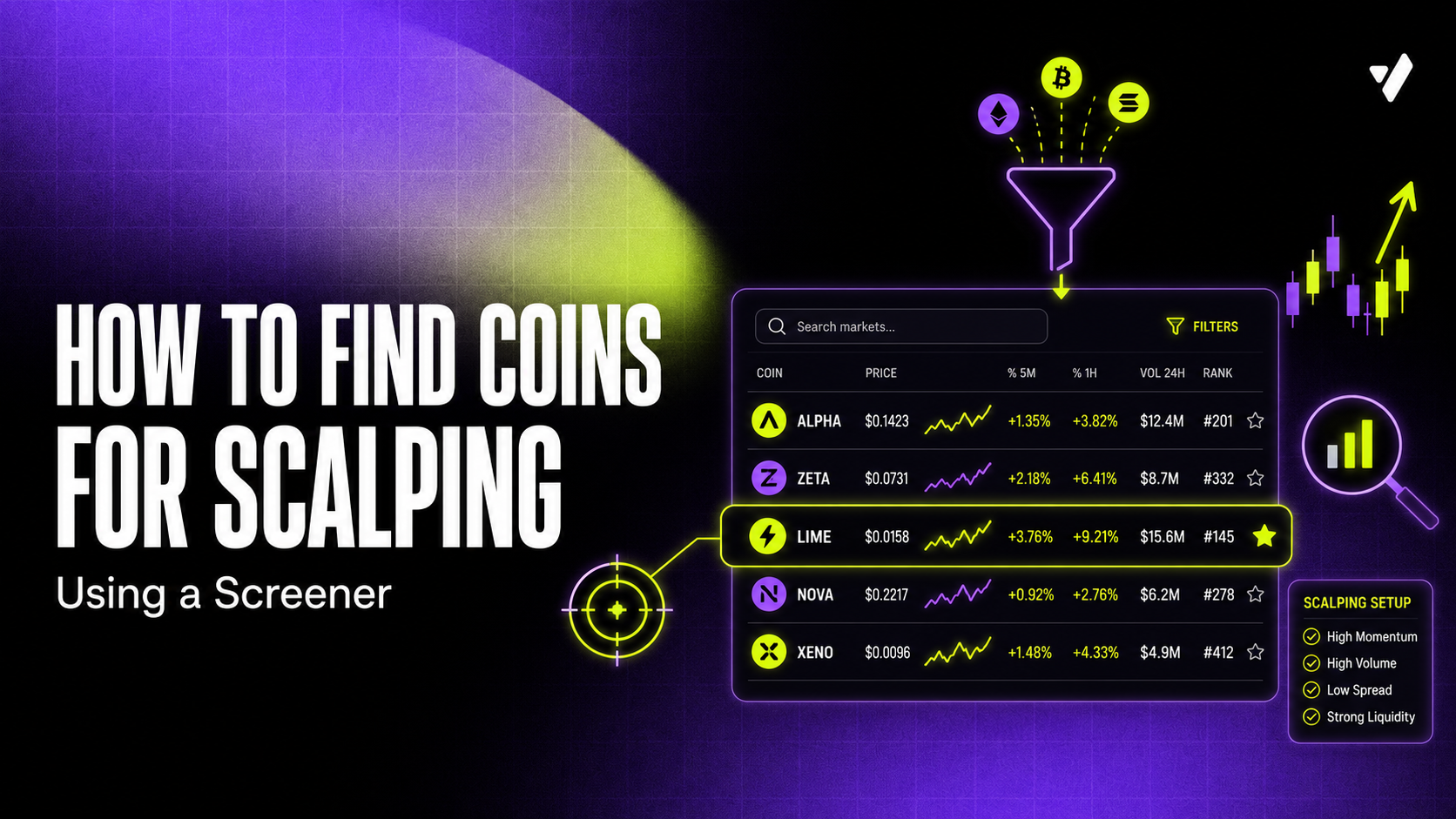
A screener is a tool that analyzes a large number of cryptocurrencies and displays them according to selected parameters. For example, a trader can sort coins by volume, price change, volatility, growth in open interest, spikes in trades, or other market metrics.
For a scalper, this is especially important. In active trading, there is no time to manually review every chart. While a trader opens one coin after another, the move may already be over. A screener shortens this path: it shows where the market has already become active.
But it is important to understand that a screener does not tell you exactly where to buy or sell. It helps find an instrument worth studying. After that, the trader looks at the chart, levels, order book, time and sales, and only then makes a decision.
A good screener for scalping does not answer the question “where will the price go?” It answers the question “where is there activity right now?”
Which Parameters to Look at in a Screener
The main mistake beginners make is searching for coins only by percentage growth. If an asset has grown by 20%, this does not always mean it should be traded immediately. Sometimes the main move has already happened, liquidity has worsened, and the entry becomes too late.
For scalping, a combination of factors matters. You need to look not only at price change, but also at volume, volatility, spread, liquidity, the order book, and the behavior of market participants.
| Parameter | What It Shows | Why It Matters for Scalping |
|---|---|---|
| Trading volume | How much of the asset is actually being bought and sold over the selected period. | The higher the volume, the easier it is to enter and exit a trade without significant slippage. |
| Price change | How much the coin has risen or fallen over a period. | Helps find assets where movement has already appeared. |
| Volatility | How actively the price fluctuates. | Without movement, a scalper has nothing to trade, but overly sharp volatility increases risk. |
| Spread | The difference between the best buy and sell price. | A wide spread reduces potential profit and worsens execution. |
| Order book liquidity | The number of orders near the current price. | Shows how comfortable it is to open and close a position. |
| Open interest | The number of open futures positions. | Growth in OI may indicate increasing interest in the instrument. |
| Funding | The balance between longs and shorts in futures. | Helps understand whether one side of the market is overheated. |
| Correlation with BTC | How closely the coin follows Bitcoin’s movement. | It is important to understand whether the asset is moving independently or simply following the market. |
One parameter alone rarely gives a high-quality signal. For example, price growth without volume may be weak. High volume without movement may indicate a struggle between participants, but not necessarily a ready trade. High volatility without liquidity can lead to poor execution.
That is why a screener should be used as a filter, not as an entry button.
How to Select Coins for Scalping
The workflow should be built step by step. First, a trader looks for active coins, then filters out unsuitable ones, and then analyzes the remaining instruments in more detail.
At the first stage, the market can be sorted by trading volume. This helps remove coins with almost no activity. After that, it is worth looking at price change over a short period: for example, 5 minutes, 15 minutes, 1 hour, or 24 hours. For scalping, short intervals are especially useful because they show fresh activity.
Then volatility should be assessed. If a coin barely moves, it will be difficult for a scalper to find a trade. But if the price moves too chaotically and candles form sharp jumps without liquidity, such an instrument can also be dangerous.
After that, it is worth moving to the order book. Even if the screener shows good volume and strong movement, you need to check whether the trade can be executed properly. If there are few orders in the order book and the spread is wide, it is better to be more cautious.
| Selection Stage | What the Trader Does | What Should Raise Concern |
|---|---|---|
| Initial filtering | Looks at the coin’s volume and activity. | Low volume, rare trades, lack of interest. |
| Finding movement | Checks price change over a short period. | Strong growth without volume or an already late impulse. |
| Volatility assessment | Looks for a workable movement range. | Chaotic candles, sharp spikes without structure. |
| Order book check | Assesses spread, liquidity walls, and order depth. | Empty order book, wide spread, poor liquidity. |
| Chart analysis | Looks for a level, pullback, breakout, or consolidation. | No clear entry point or risk zone. |
| Final decision | Compares the scenario, risk, and trade potential. | Entering only because the coin is “already flying.” |
This approach helps avoid trading everything at once. A scalper chooses only those instruments where there is not just movement, but a clear market situation.
Which Coins Are Suitable for Scalping?
A good coin for scalping usually has several characteristics. It has volume, active participants, sufficient volatility, and normal liquidity. The price does not stand still, but it also does not move completely chaotically. The order book allows the trader to enter and exit without significant slippage. The chart has levels, ranges, impulses, or zones from which a trade can be built.
At the same time, it is not necessary to trade only the largest assets. Bitcoin and Ethereum often provide good liquidity, but they do not always offer enough short-term movement for active scalping. Some altcoins may be more interesting if volume, news, a strong impulse, or local activity has appeared in them.
But it is important not to confuse activity with danger. If a coin has grown by 80% in a short period of time, the order book has become thin, and candles are moving in sharp jumps, this may be a trap rather than an opportunity. Scalping requires controlled risk. If the risk cannot be calculated properly, it is better to skip the instrument.


How to Use a Screener Together with the Order Book
A screener shows where activity has appeared. The order book helps understand how this activity is being implemented in the moment.
For example, a screener shows that a coin’s volume has increased sharply over the last 15 minutes. This is a reason to open the instrument and see what is happening inside. On the chart, you may see a breakout from a range. In the order book, there may be large orders near the price. In the time and sales, there may be active market buys.
If all these elements align, the situation becomes more interesting. But if the screener shows volume growth while the order book is empty, the spread is wide, and the price is jumping randomly, it is better not to rush.
For a scalper, it is important to see not only the fact of movement, but also its quality. A move can be stable when volume enters the market and the price holds levels. Or it can be artificial or too thin, when several large trades create a sharp jump without continuation.
Example of Finding a Coin Through a Screener
Imagine that a trader opens a screener before the start of a trading session. They sort coins by volume growth over the last hour and see that one altcoin has sharply moved up in activity. The price has grown by 6%, volume has increased, and open interest in futures has also started to rise.
At this stage, it is still too early to open a trade. The screener has only highlighted the instrument.
Next, the trader opens the chart and sees that the price has broken out of a local range. After the impulse, the market pulls back to the breakout zone. This is already a potential scenario. Then the trader checks the order book: buy orders have appeared near the pullback zone, the spread remains narrow, and liquidity has not disappeared.
Now the trade has logic. The trader may look for an entry from the zone where the price is holding the breakout. The stop is placed behind the level, and the target is near the closest resistance area or where the movement starts to slow down.
In this situation, the screener did not provide a ready-made signal. It helped find a coin that had become active. The actual entry point appeared only after analyzing the chart, order book, and risk.
How the Screener and Entry Point Are Connected
Many beginners want the screener to immediately show them the entry point. But this is the wrong expectation.
The screener is responsible for instrument selection. It helps understand which coin is worth opening and studying. The entry point is formed only after analyzing a specific market situation.
For example, a screener may show a coin with high volume and strong movement. But if the price is far away from a level, it is too late to enter. In that case, it is better to wait for a pullback, consolidation, or a retest of the zone.
And vice versa: the chart may show a clean level, but if the coin is inactive, there is no volume, the order book is empty, and the spread is wide, that entry point may be poor.
That is why a quality trade appears at the intersection of two factors: an active coin plus a clear entry scenario.
| What the Screener Shows | What the Chart and Order Book Show |
|---|---|
| Where activity has appeared. | Where to look for an entry point. |
| Which coins have increased in volume. | Whether there is a level, pullback, breakout, or range. |
| Which assets are moving stronger than the market. | Whether it is possible to enter with clear risk. |
| Where open interest has changed. | Whether there is confirmation in the order book and time and sales. |
| Which instruments are worth opening for analysis. | Whether it actually makes sense to open a trade. |
That is why it is better to think of a screener as the first stage of the trading process, not as a standalone strategy.
Which Filters Beginners Should Use
A beginner should not immediately build a complex system with dozens of parameters. The more filters there are, the higher the risk of getting confused and starting to look not for the market, but for a perfect match of conditions.
To start, a few basic filters are enough: volume, price change, volatility, spread, and liquidity. This is already enough to filter out most weak instruments.
| Filter | How to Use It | What to Look For |
|---|---|---|
| 24-hour volume | Filter out coins without activity. | Instruments with stable trades and participants. |
| 5–15 minute volume | Find a fresh spike in interest. | Coins where activity has appeared right now. |
| Price change | Understand the direction of movement. | Growth or decline accompanied by volume. |
| Spread | Check execution quality. | A narrow spread where the trade does not immediately start with a large loss. |
| Volatility | Assess movement potential. | A sufficient range for short trades. |
| Order book | Check liquidity. | Orders near the price, clear liquidity walls, no emptiness. |
This set of filters helps quickly find coins for trading without overloading the analysis. As the trader gains experience, additional parameters can be added: open interest, funding, correlation with BTC, spikes in prints, news, and chart patterns.
Mistakes When Searching for Coins Through a Screener
The most common mistake is trading a coin immediately after it appears among the top gainers. A beginner sees a strong move and thinks it is a signal to enter. But often, by that moment, the main part of the impulse has already happened, and the risk becomes higher.
The second mistake is ignoring liquidity. A screener may show a large percentage gain, but if the order book is empty, it will be difficult to execute the trade properly. This is especially dangerous with smaller altcoins.
The third mistake is looking at only one timeframe. For example, a coin may rise sharply over 5 minutes, but on a wider chart it may be running into strong resistance. Without context, the trader may open a trade exactly in the zone where other participants are starting to take profit.
The fourth mistake is using the screener instead of a trading plan. Even if an instrument looks interesting, the trader must understand in advance where the entry is, where the exit is, where the stop is, and why the trade makes sense.
The fifth mistake is trying to trade too many coins at the same time. A screener may show dozens of active instruments, but a trader’s attention is limited. It is better to choose a few high-quality situations than to superficially monitor the entire market.

What Algorithm to Use Every Day
A working algorithm may look like this. First, the trader opens the screener and looks at the general market activity. If most coins are moving weakly, it is worth being more cautious and not looking for trades where there are none. If the market is active, the trader can move on to selection.
Then the trader sorts instruments by volume and price change over a short period. Coins with poor liquidity, a wide spread, and overly chaotic movement are removed from the list. After that, several assets remain that are worth studying in more detail.
Next, the chart is opened. The trader looks for structure: a level, range, breakout, pullback, impulse, or consolidation. If there is structure, the order book and time and sales are checked. If there is no confirmation, the instrument is put aside.
Only after that does the question of a trade appear. In other words, the order should always be the same: first coin selection, then situation analysis, then searching for an entry point, and only after that opening a position.

A screener helps a scalper find active coins faster and avoid wasting time manually reviewing the entire market. But on its own, it is not a trading strategy. Its task is to highlight instruments where activity, volume, and potential movement have appeared.
For quality selection, it is important to look not only at price growth, but also at volume, volatility, spread, liquidity, the order book, and market context. Strong movement without proper execution can be more dangerous than a calm coin with a clear structure.
That is why searching for coins for scalping through a screener should be part of a system. First, the trader finds an active instrument, then checks the chart, order book, and time and sales, then looks for an entry point and defines risk in advance. This approach helps avoid chasing every rising coin and focus only on situations where there is real trading logic.