



Crypto Futures Scalping Strategies: A Practical Guide
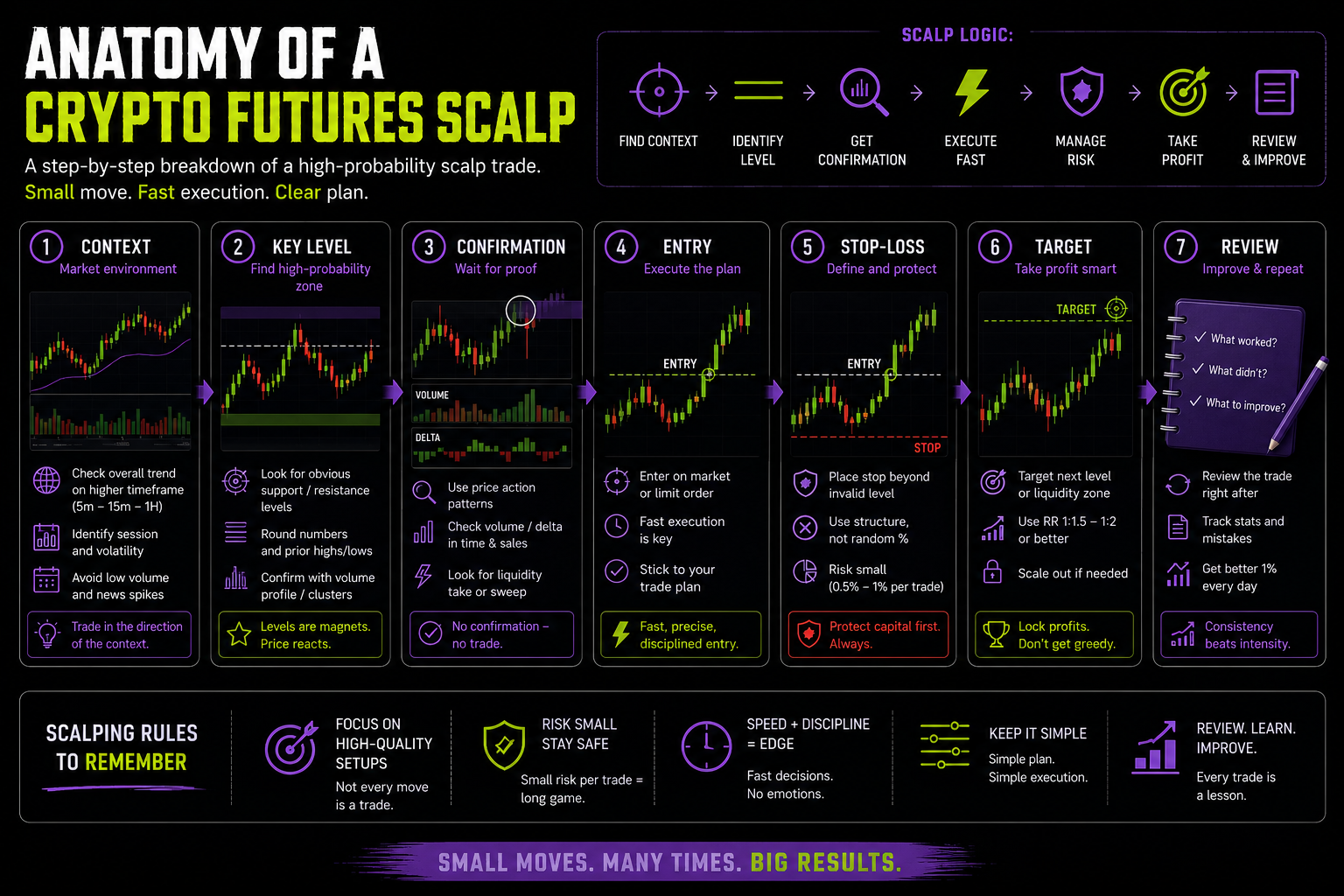
Futures scalping focuses on small price movements that may last from seconds to several minutes. The trader first chooses a liquid contract, marks the market structure and key level, then waits for confirmation from price action, volume, the order book, or time and sales. Leverage should never determine risk; position size should be calculated from the stop distance and the amount the account can lose. The most effective approach is usually one clear setup, strict daily limits, and detailed review after the session.
Table of Contents
What Does Crypto Futures Scalping Involve?
Scalping is a fast-paced form of day trading. A trader aims to capture a small price change instead of holding a position for hours or days. Some trades last only a few seconds; others remain open for several minutes while the expected movement develops.
In futures trading, a trader can enter long positions when expecting prices to rise or sell short when expecting a decline. Because both directions are available, opportunities may appear during bullish, bearish, and range-bound market conditions. The same flexibility also creates additional risk: leverage magnifies gains and losses, and poor execution can quickly damage the account.
The main advantage of futures scalping is not the number of trades. It is the ability to define a short-term scenario with a clear entry, stop, and target. A professional process may involve many observations but only a few actual positions. Scalpers spend much of their time waiting for liquidity, momentum, and structure to align.
These setups work best when the trader understands why the market may move from one price area to another. A signal from RSI, moving averages, or a chart pattern is not enough by itself. The setup should explain who may be trapped, where orders are concentrated, which side is acting aggressively, and where the trade becomes invalid.
How Perpetual Futures Work
Most active crypto derivatives are perpetual contracts. They have no expiry date, so exchanges use funding payments to keep the contract close to the underlying spot market. Depending on the rate, long traders may pay short traders or the reverse. Even if a scalp lasts only minutes, the trader should know the next funding time and the platform’s calculation method.
A futures position uses margin. Leverage changes exposure relative to that margin, but it does not define acceptable risk. An oversized position can suffer significant damage from a small adverse move, and liquidation may occur when maintenance requirements are breached. Some exchanges use mark price rather than the last traded price in liquidation logic.
Before trading, check the settlement asset, tick and lot size, maker and taker costs, margin mode, supported orders, reduce-only settings, and liquidation rules. These details directly affect execution and should be understood before any real position is opened.
Futures Scalping Versus Spot Scalping
Spot and futures charts may look similar, but the trading process is not identical.
| Factor | Spot Market | Crypto Futures |
|---|---|---|
| Exposure | Trader buys or sells the actual asset. | Trader opens a derivative position. |
| Direction | Long is standard; short access varies. | Long and short are normally available. |
| Leverage | Usually absent or limited to margin products. | Common, with liquidation risk. |
| Funding | No perpetual funding payment. | Funding may be paid or received. |
| Price references | Last traded price is central. | Last, index, and mark price may differ. |
| Costs | Trading fee, spread, slippage. | Trading fee, spread, slippage, possible funding. |
| Risk controls | Stop and position sizing. | Stop, sizing, margin mode, leverage, liquidation distance. |
Futures may use capital more efficiently, but they are not safer. Set monetary risk first and calculate quantity from the stop distance. Futures trading scalping strategies also need a specific plan for short exposure because squeezes, liquidation clusters, and thin offers can punish late sellers quickly.
How to Select a Contract for Scalping
Choose a liquid contract where the expected move can cover costs and the order book can absorb the planned size. Check volume, spread, depth, and how quickly liquidity disappears when active orders hit the market. A tight spread helps, but it does not compensate for a thin book.
Then assess structure and relative strength. A clean trend, defined range, or visible reaction area is easier to manage than random swings. Compare the contract with Bitcoin and the broader crypto market, because an altcoin setup can fail when the market leader breaks an important level.
| Selection Factor | Useful Sign | Warning Sign |
|---|---|---|
| Spread | Stable and tight near current price. | Expands sharply during normal activity. |
| Depth | Enough resting liquidity for planned size. | Thin book and large gaps between levels. |
| Volume | Consistent active trading. | One isolated spike with no follow-through. |
| Structure | Clear trend, range, or reaction level. | Random swings with no invalidation point. |
| Relative strength | Coin behavior is understandable versus Bitcoin. | Correlation changes unpredictably. |
| Contract data | Funding, open interest, and liquidation risk are visible. | Important information is unavailable. |
A screener can reduce the search time by filtering contracts by volume, volatility, open interest, or recent change. It should create a shortlist, not issue a command to enter. The actual setup still comes from the chart, order flow, and risk calculation. Vataga’s educational materials use the same sequence: screening first, then chart and order-book analysis before the actual entry.
Build a Workspace for Fast and Controlled Execution
Scalping requires quick access to information, but speed should remove unnecessary actions rather than encourage impulsive trading. A practical workspace combines the chart, order book, time and sales, position panel, active orders, and risk information in one view.
The chart gives structure, the order book shows available bids and offers, and time and sales confirms what has traded. Open interest, funding, mark price, and liquidation data add derivatives context. Hotkeys can reduce delay, but every command must be tested with minimal size; a wrong quantity or missing reduce-only flag can create a new position instead of closing one.
Vataga.terminal provides multi-window trading tools and has added futures-specific information such as Mark Price changes and ADL risk in the order book. These features can help a trader monitor position risk without switching between several platforms.
A Four-Part Entry Framework
Before comparing futures trading scalping strategies, define a framework that every setup must pass. This prevents a trader from treating a single indicator or candle as sufficient evidence.
The first part is context. Identify whether the market is trending, ranging, compressing, or reacting to a major event. The second part is location: support, resistance, a prior high or low, a volume area, or the edge of a range. The third part is confirmation, such as momentum returning with the trend, failed continuation, absorption, or increased volume. The fourth part is risk: the stop must sit beyond the point that disproves the idea, and the target must justify the expected costs.
| Component | Question to Answer |
|---|---|
| Context | What type of market is active now? |
| Location | Why should buyers or sellers react here? |
| Confirmation | What observable change supports the entry? |
| Risk | Where is the setup invalid, and is the reward sufficient? |
If one component is missing, the trader should avoid the trade. A beautiful pattern in the middle of random price action is not a complete setup. A strong level without confirmation may be broken. Good execution cannot rescue an idea with no logical invalidation.
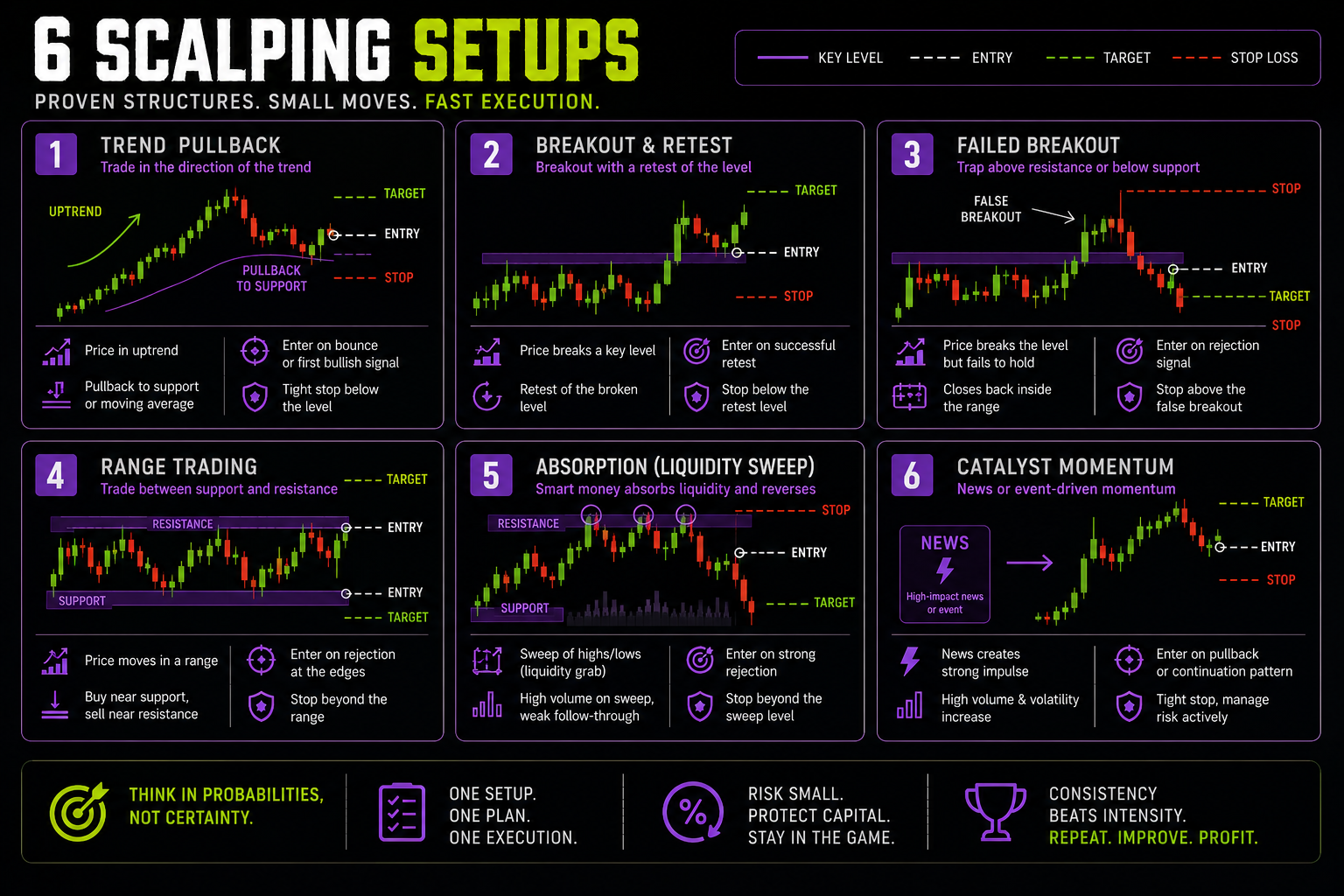
Six Practical Setups
Strategy 1: Trend Pullback
The trend-pullback setup looks for continuation after a temporary move against the main direction. In an uptrend, price makes higher highs and higher lows, then returns toward support, a prior breakout area, or a moving average that other participants are watching. In a downtrend, the logic is reversed.
The entry should not be based only on the first touch. Wait for the counter-move to weaken. Useful evidence may include smaller candles, reduced selling volume during a bullish pullback, failed attempts to push through support, or renewed aggressive buying. The stop belongs beyond the structure that would invalidate continuation.
This is one of the crypto futures scalping strategies that can be applied without predicting a full reversal. The trader is aligning with the current direction and aiming for a retest of the recent swing or a nearby liquidity area.
A common mistake is to enter after the market has already resumed the trend and moved too far from the stop location. The direction may be correct, but the timing produces poor reward relative to risk. Another mistake is treating every dip as a pullback even after the structure has changed.
Strategy 2: Breakout and Retest
A breakout setup begins with a well-defined level or range. Price may compress near resistance, repeatedly test support, or build volume at one boundary. The trader waits for the market to move beyond that area with enough participation to suggest acceptance at new prices.
The safest entry is not always the first market order through the level. A retest can offer clearer risk: the broken resistance acts as support, or broken support acts as resistance. Confirmation may come from renewed volume, rejection back toward the breakout direction, or an order-book imbalance that prevents price from returning to the old range.
Among futures trading scalping strategies, breakout trading is particularly sensitive to costs and slippage. When many traders enter at the same time, spreads can widen and market orders may fill across several prices. Limit orders improve price control but may not execute.
A failed retest invalidates the setup. Holding simply because the original breakout looked strong turns a short-term idea into an uncontrolled position.
Strategy 3: Failed Breakout and Liquidity Sweep
Markets often move beyond an obvious high or low, trigger stops and breakout entries, then return inside the prior structure. This is commonly described as a failed breakout or liquidity sweep.
The setup requires more than a wick. The trader should see that price cannot maintain acceptance outside the level. For example, buyers push above a range high, but momentum fades, executed volume no longer produces progress, and price returns below resistance. A short entry may become valid after the return is confirmed. The stop is placed beyond the failed extreme.
This is another of the crypto futures scalping strategies where order flow can add useful information. Aggressive buyers may appear strong, yet the lack of upward progress shows that a larger seller is absorbing demand. The reverse can occur below support.
The risk is entering too early while the sweep is still developing. Strong trends can pause above a level and then continue. The trader needs evidence of rejection, not only an overbought reading or personal belief that the move has gone too far.
Strategy 4: Range Scalping
A range forms when price repeatedly reacts between support and resistance without establishing a lasting trend. The basic idea is to buy near the lower boundary and sell near the upper boundary, while avoiding entries in the middle.
Range setups depend on clear boundaries and repeated reactions. The best entries often occur after a failed attempt to leave the range, because the invalidation point is close and visible. Volume may decline toward the edge and increase as price rotates back inside.
Range-based futures trading scalping strategies fail when the market transitions into a directional phase. A trader who repeatedly fades the edges can suffer several losses if new information creates a strong breakout. This is why each attempt needs a stop outside the structure and why the number of retries should be limited.
RSI can help describe whether momentum is stretched, but overbought does not automatically mean sell and oversold does not automatically mean buy. In a strong trend, the indicator may remain extreme for a long time. Use it as supporting data, not as the entire trading strategy.
Strategy 5: Order-Book Absorption
Absorption occurs when aggressive market orders hit a level but fail to move price through it. A large limit buyer may absorb repeated sells at support, or a limit seller may absorb buys at resistance.
The order book alone cannot confirm absorption because visible liquidity may be canceled. The trader needs time-and-sales data or another execution view to verify that trades are actually occurring at the level. The key relationship is effort versus result: strong selling with little downward progress can signal a buyer; strong buying with little upward progress can signal a seller.
Crypto futures scalping strategies based on absorption require reliable real-time data and practice reading depth. The setup can offer a tight invalidation, but it is vulnerable to spoofing, hidden liquidity, and sudden removal of the defending order.
The position should be closed quickly if the defended level gives way. There is no reason to hold and hope after the main premise disappears.
Strategy 6: Momentum After a Catalyst
Momentum scalping follows a rapid move caused by news, a listing, a market-wide breakout, liquidation activity, or another catalyst. The goal is to join continuation while participation remains strong, not to buy after the move is exhausted.
A useful momentum setup combines direction, volume, liquidity, and room to the next level. The trader may enter after a brief consolidation, a shallow pullback, or a clean break of a local structure. The stop should account for higher volatility but remain small enough to fit the account’s risk limit.
This is the last of the six crypto futures scalping strategies in this guide, and it requires the fastest decision-making. During sharp events, spreads expand, slippage increases, and the order book changes quickly. A setup that looks profitable using the last price may be unattractive at the actual fill.
If the trader cannot define the exit before entering, the move should be skipped. There will always be new opportunities; preserving financial and emotional capital is more important than catching one candle.
How to Use Indicators Without Building an Indicator Maze
Technical indicators can organize information, but they should not replace market logic. Moving averages help describe trend and dynamic support or resistance. RSI measures momentum relative to recent changes. Volume shows participation. None of them can guarantee what the next trade will do.
A simple indicator framework is often enough. For example, use market structure and averages to define direction, volume to confirm participation, and RSI only to spot a momentum divergence or stretched condition. Then use price action to decide whether the market is actually reacting.
Futures scalping strategies become harder to evaluate when many correlated indicators are placed on the same chart. Three momentum tools may appear to provide confirmation, but they are often processing the same prices in slightly different ways. A clear setup should still make sense when most indicators are removed.
Backtesting can reveal whether rules had historical potential, but live results also depend on spread, fees, queue position, and slippage.
Fees, Spreads, and Slippage
Scalpers target small moves, so costs are part of the setup. Trading fees apply when opening and closing. The bid-ask spread creates an immediate disadvantage for market orders. Slippage occurs when available liquidity cannot fill the full quantity at the expected price.
Suppose a setup aims for a gain of 0.20%, but total fees and execution costs consume 0.08%. The strategy has lost a significant part of its potential before considering losing trades. If the stop is also 0.20%, the break-even win rate is higher than the chart alone suggests.
Maker orders may reduce costs or qualify for a different fee rate, but they do not guarantee execution. Taker orders provide speed but pay for immediate liquidity. The appropriate order depends on the setup. A slow range entry may support a limit order, while a rapid breakout may require a marketable instruction.
Every performance review should record gross result, fees, funding if applicable, and estimated slippage. Without those fields, the trader does not know whether the edge is real.
Position Sizing and Leverage
Risk management begins with a monetary limit, not a leverage setting. Decide how much the account may lose if the stop is reached. Then measure the distance between entry and invalidation and calculate the position quantity.
A simple relationship is:
Position size = acceptable monetary loss ÷ stop distance as a decimal
If the account can risk 20 USDT and the logical stop is 0.40% away, the theoretical position value is 5,000 USDT before adding fees and slippage. Because actual execution may be worse, a prudent trader uses a slightly smaller size.
Leverage changes the margin required for that position. It does not change the loss produced by a given position value and price move. Using higher leverage simply reduces the distance to liquidation and leaves less room for error. Official exchange materials also warn that leveraged perpetual trading can produce rapid liquidation during volatile moves.
Futures trading scalping strategies should therefore be tested with the same risk unit. If one setup risks 10 USDT and another risks 100 USDT, the trader cannot compare their performance fairly.
Stop Placement and Profit-Taking
A stop should sit where the trading idea is wrong, not at an arbitrary distance that feels comfortable. In a breakout, the stop may be inside the prior range. In a failed breakout, it may be beyond the sweep extreme. In an absorption setup, it belongs beyond the defended level.
Tight stops reduce the amount lost per unit of position, but a stop that sits inside normal market noise will trigger too often. Wide stops increase loss per unit and force a smaller position. The correct distance comes from structure and volatility.
Profit-taking can be fixed, partial, or dynamic. A fixed target improves consistency. Partial exits reduce exposure while allowing the remaining position to continue. A trailing approach can capture larger moves but may return more open profit during pullbacks.
The exit model should match the setup. A range scalp usually targets the middle or opposite side of the structure. A momentum trade may use the next liquidity level or trail behind short-term swings. The trader should decide before entry rather than improvise after seeing unrealized gains.
Daily Limits and Loss Control
Define a maximum daily loss, an attempt limit for one setup, and a condition that ends the session when execution quality falls. These rules protect the account after frustration, fear, overconfidence, or several losses in a row.
The same discipline matters after strong gains. Once a trader exceeds the daily goal, careless entries can return the profit to the market.
| Risk Control | Purpose |
|---|---|
| Fixed loss per trade | Prevents one position from dominating the account. |
| Daily drawdown limit | Stops revenge trading. |
| Attempt limit | Prevents repeated entries into a failed idea. |
| Maximum size | Blocks emotional increases in exposure. |
| Session review | Separates process quality from money. |
This discipline is central to all futures trading scalping strategies. Without it, a valid entry method still lacks a reliable business process.
Trading During News and Rapid Volatility
News can create significant moves, but it also changes execution conditions. Liquidity may disappear, spreads widen, and market orders fill far from the visible price. Stops can execute with slippage, especially when many participants react at the same time.
Before a scheduled event, check whether the expected volatility fits the strategy. Some traders avoid the first seconds and wait for a range or pullback to form. Others trade only after the initial direction becomes clear. Both approaches are more structured than entering because the candle is large.
Unexpected news is harder. If the market becomes too fast to manage, reducing size or staying flat is a valid decision. A strategy is only effective when the trader can execute it under the current conditions.
Crypto futures scalping strategies should include an explicit rule for events: trade, wait, reduce size, or avoid. Without that rule, the trader is likely to switch from analysis to impulse.
Psychology and Decision-Making
Scalping produces frequent feedback. Every fill, unrealized change, and stop can influence the next decision. This makes emotional control part of execution.
Common problems include chasing a move after missing the planned entry, holding a loss because closing feels painful, taking gains too quickly, and increasing size to recover. These behaviors are not corrected by adding more tools. They require strict rules, smaller risk, and review.
A pre-trade checklist helps. Confirm the context, level, trigger, stop, target, quantity, and event risk. After the trade, record whether the rules were followed. A profitable rule violation should be marked as an error, while a controlled loss taken according to plan may be a good trade.
Futures scalping strategies are easier to follow when the trader uses one or two setups and knows their normal losing patterns. Confidence should come from a sample of trades, not from one impressive result.
A Note About Futures Combines and Prop Evaluations
Searches for the best futures combines for scalping strategies usually refer to proprietary-trading evaluation programs, not directly to crypto exchange accounts. Such programs may set daily loss limits, consistency rules, restricted news periods, minimum trading days, or limits on holding positions.
When comparing the top futures combines for scalping strategies, check whether short holding periods, rapid order placement, automated tools, and the intended market are permitted. A profitable method can still violate an evaluation rule. Also confirm whether the program offers regulated futures, crypto derivatives, or only simulated exposure; these are different environments with different costs and execution.
The word “combines” should not distract from the central issue: the trader needs a strategy that remains viable after platform rules, fees, and risk limits are applied.
How to Practice Without Rushing Into Full Size
Start by observing one setup across different market conditions. Save charts that show valid signals, failures, and situations where the trigger never appeared. Then move to replay, simulation, or minimal live size.
Simulation helps with rules and order placement, but it cannot fully reproduce emotional pressure, queue position, or slippage. Minimal live trading adds real experience while keeping losses controlled.
| Stage | Goal | Requirement Before Moving On |
|---|---|---|
| Observation | Recognize the setup. | Clear context and invalidation on saved charts. |
| Simulation | Execute the rules. | Few operational mistakes. |
| Minimal live size | Test costs and emotions. | Stable rule compliance. |
| Review | Measure expectancy and drawdown. | A meaningful sample of trades. |
| Scaling | Increase exposure gradually. | Performance remains stable. |
Do not scale because one day was profitable. Increase size only when execution quality and drawdown remain acceptable.
How to Evaluate Strategy Performance
A trading journal should track average gain, average loss, net result after costs, maximum drawdown, time of day, contract, setup type, and rule compliance. Win rate alone is not enough: a method can be profitable with fewer winning trades if gains are larger than losses, and unprofitable with a high win rate if occasional losses are uncontrolled.
Separate statistics by setup and compare planned execution with actual fills. Late entries, inconsistent exits, fees, and slippage may destroy an idea that looked profitable on candles. Scale only after a meaningful sample shows positive expectancy and stable rule compliance.


Final Takeaways
Crypto futures offer long and short exposure, leverage, and active markets, but they also add liquidation, funding, and execution risk. A durable process begins with contract mechanics, liquid market selection, and a workspace that supports fast but controlled action.
The most useful setups share the same structure: context, location, confirmation, invalidation, and predefined size. Indicators may support the analysis, but they should not replace liquidity, price behavior, and actual execution data.
The six methods covered here should be tested separately because they react differently to volatility, trading times, and market structure. Start with one setup, one or two liquid contracts, and minimal risk. Track fees and slippage, respect the daily limit, and scale only after a meaningful sample shows stable execution. The goal is not to trade constantly; it is to make precise decisions while keeping losses small.